
cGate
Extends capability and reach through infrastructure that connects people, services, institutions, and opportunity.
Infrastructure Determines Reach. Learn more →Architecture
ManChine AI Technology develops standards-aligned governance-layer architecture that helps consequential AI systems remain governable as authority, evidence, policy, context, and operational conditions evolve throughout execution.
This architecture separates reach infrastructure, Runtime Governance Evaluation, runtime enforcement, and Runtime Integrity Control from product implementations. That separation preserves clear responsibility while supporting operational continuity and legitimacy continuity.
Why It Matters
Infrastructure moves capability. Runtime Governance Evaluation determines whether consequential execution is admissible. The Runtime Execution Boundary enforces that determination. Runtime Integrity Control preserves legitimacy as conditions change.
Architecture Overview
Capability → cGate → RGE-01 → Admissibility Determination → REB-01 → Consequential Execution → RiCo-01 → Continuity
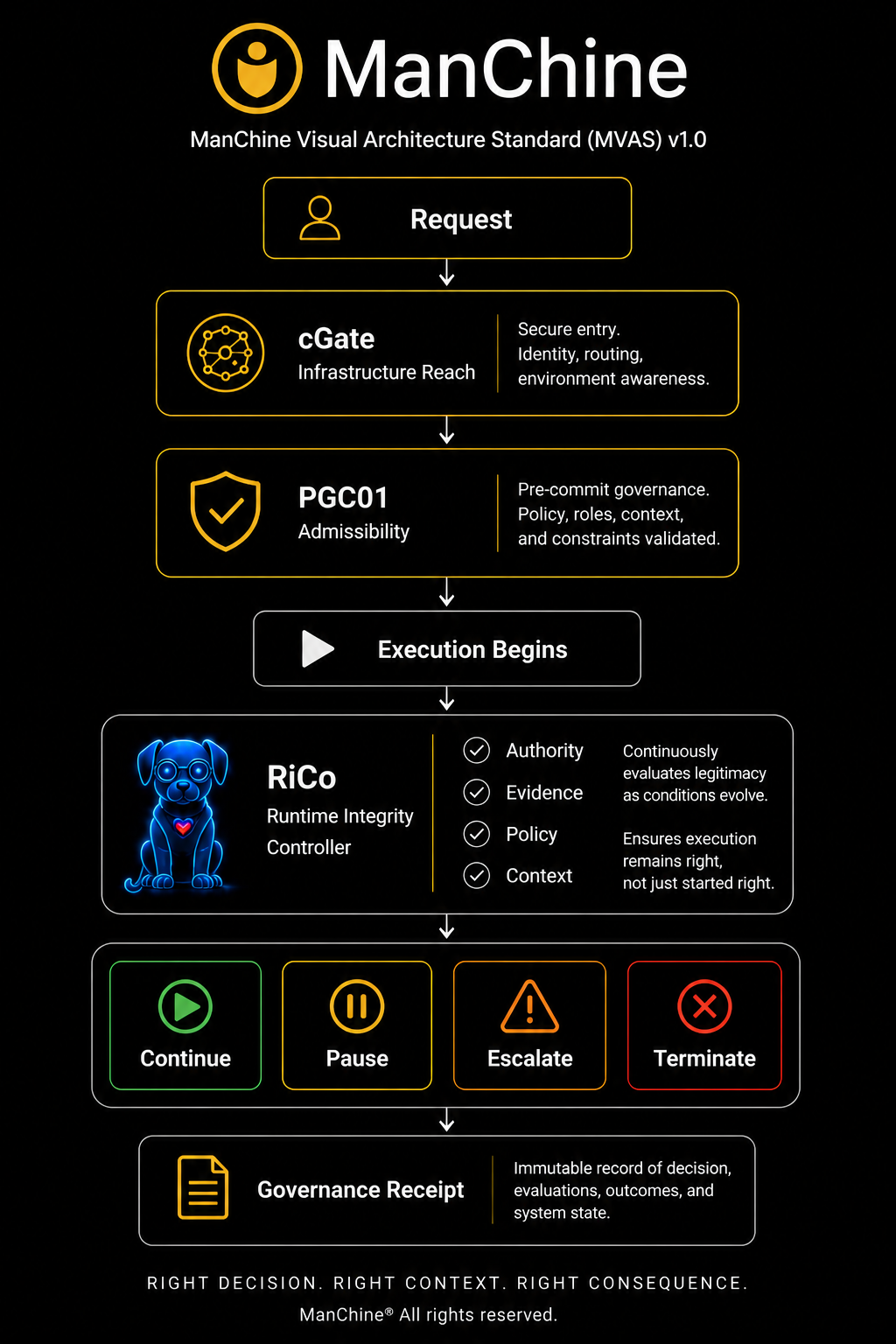
How It Works Together
The standards architecture separates infrastructure reach, governance evaluation, and runtime integrity so that no product or implementation silently absorbs another responsibility.
Extends capability and reach through infrastructure that connects people, services, institutions, and opportunity.
Infrastructure Determines Reach. Learn more →Evaluates current authority, evidence, policy, and context to produce the Admissibility Determination before consequential execution.
Governance Determines Admissibility. Learn more →Enforces the Runtime Execution Boundary by applying the Admissibility Determination before consequential execution may begin.
Boundary Enforces Execution. Learn more →Preserves runtime integrity and legitimacy continuity after execution activation while consequential execution remains active.
Continuity Preserves Trust. Learn more →Why These Responsibilities?
Question: Can capability reach the required people, services, and systems?
Answer: cGate provides infrastructure and connectivity outside the normative Runtime Governance Standards scope.
Question: Do current governance conditions support consequential execution?
Answer: RGE-01 evaluates authority, evidence, policy, and context and produces the Admissibility Determination.
Question: May consequential execution cross the Runtime Execution Boundary?
Answer: REB-01 enforces the Admissibility Determination before execution begins.
Question: Does consequential execution remain legitimate after activation as conditions change?
Answer: RiCo-01 preserves runtime integrity and continuity while execution remains active.
Infrastructure supports reach. RGE-01 evaluates admissibility. REB-01 enforces the boundary. RiCo-01 preserves runtime integrity and legitimacy continuity. Together they form a coherent operating architecture without collapsing standards into products.
Standards and Platform
The Runtime Governance Standards define vendor-independent responsibilities such as RGE-01, REB-01, and RiCo-01. cGate remains ManChine infrastructure outside the normative standards scope, while PGC01 is an implementation platform that may deliver standards-aligned capabilities.
Define the common vocabulary, principles, reference architecture, behavioral responsibilities, artifacts, and conformance requirements.
Explore Standards & Research →Phone, Glasses, and Case form a ManChine product platform through which Runtime Governance capabilities may be delivered. PGC01 is not the RGE architectural responsibility.
Explore PGC01 →Business Value
The architecture is designed to reduce unauthorized execution while preserving accountability as systems evolve.
The ManChine Continuity Architecture helps reduce governance gaps, strengthen accountability, improve resilience, and preserve trust in consequential AI systems.
Technical Architecture Specification
TAP-001 is an earlier technical architecture package documenting the development of Runtime Integrity Control and related runtime-governance concepts. The current standards family now separates vocabulary, architectural foundations, reference architecture, behavioral responsibilities, artifacts, and conformance.
Research
The ManChine architecture continues to evolve through the Runtime Governance Standards Series, technical review, implementation experience, and research in runtime governance, interoperability, continuity, and consequential AI.
Next Step
The question is whether it should. That is the architectural problem ManChine was created to address.