
Authority
Who is permitted to act, approve, delegate, or refuse the proposed commitment?
Runtime Governance Standards · Behavioral Specification
Runtime Governance Evaluation examines current authority, evidence, policy, and context to determine whether consequential execution remains admissible.
RGE-01 defines an architectural responsibility, not a product or deployment model. It produces an Admissibility Determination that may be enforced at the Runtime Execution Boundary.
Runtime Context
RGE-01 assumes that capability has already been connected through cGate and has achieved operational reach. Runtime Governance Evaluation begins only after capability is available for consequential execution.
Runtime Governance Evaluation Flow
RGE-01 evaluates current authority, evidence, policy, and context to produce an Admissibility Determination before consequential execution is permitted to cross the Runtime Execution Boundary.
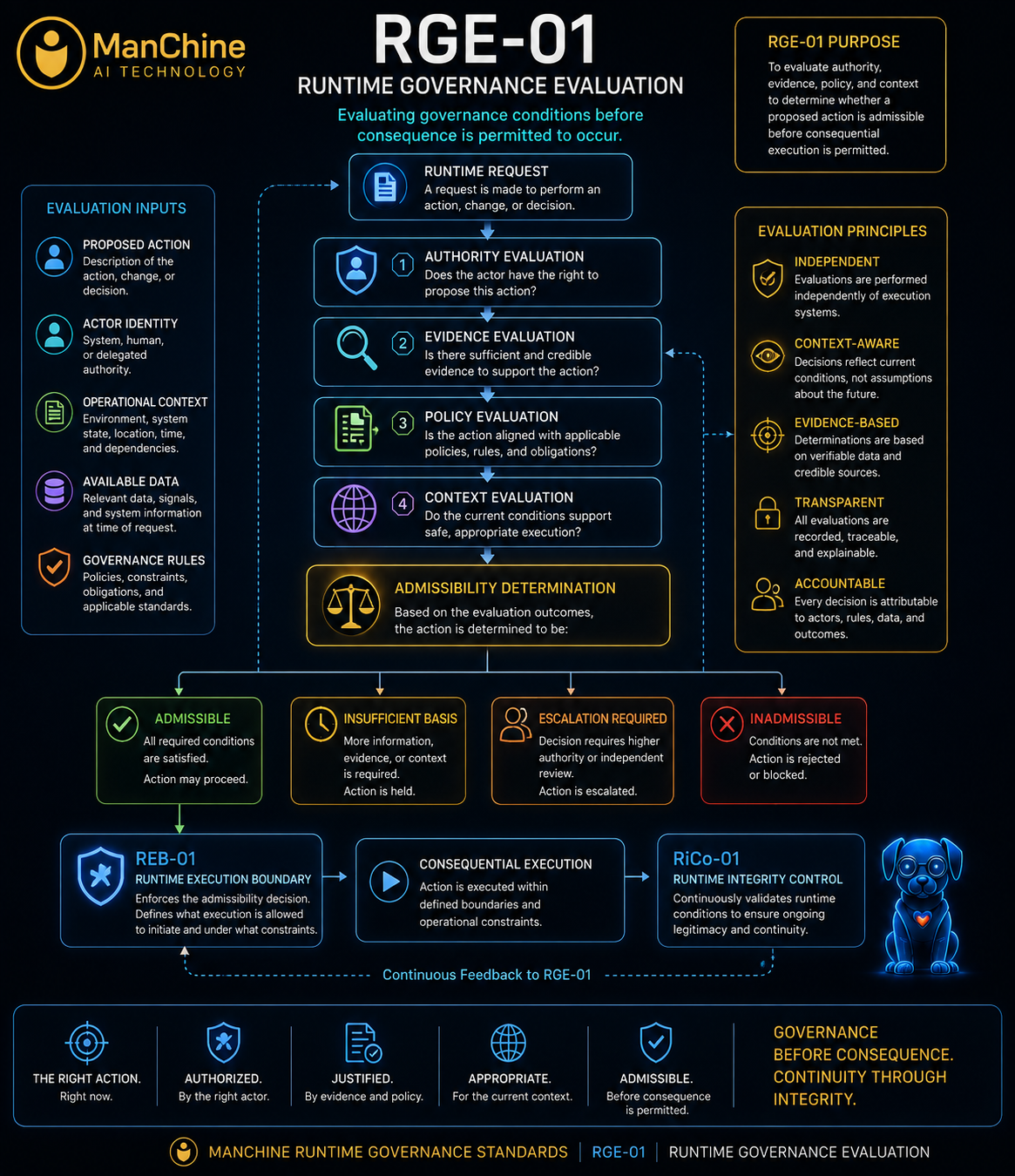
Governance Before Consequence
A system may have reach, resources, intelligence, and momentum. But before action becomes consequence, the conditions for legitimate commitment must be evaluated.
RGE evaluates whether current authority, evidence, policy, and context support an admissibility determination before consequential execution is permitted.
Governance Domains
RGE evaluates the current governance conditions that determine whether consequential execution is admissible within an operational environment.
Who is permitted to act, approve, delegate, or refuse the proposed commitment?
What supports the action, and is the evidence sufficient for the current context?
Does the proposed action remain aligned with governing rules, constraints, and obligations?
Do present operational conditions, dependencies, identities, and execution circumstances continue to support legitimate execution?
The combined evaluation produces the architectural outcome that determines whether execution may proceed, must pause, requires escalation, or must be denied.
Core Distinction
RGE produces the Admissibility Determination that states whether consequential execution may proceed.
Its purpose is not control for its own sake. Its purpose is admissibility: ensuring that action, authority, and evidence remain aligned before commitment occurs.
Decision States
When governance conditions are evaluated, RGE produces one of the defined admissibility outcomes.
Current governance conditions support consequential execution.
Required evidence, authority, policy, or context is incomplete or not current.
The evaluation requires higher authority, additional review, or another defined governance path.
Current governance conditions do not support consequential execution.
How RGE Fits the Architecture
RGE-01 evaluates current authority, evidence, policy, and context.
Admissibility Determination is the architectural outcome produced by that evaluation.
REB-01 enforces whether consequential execution may cross the Runtime Execution Boundary.
RiCo-01 preserves runtime integrity and continuity after execution activation while consequential execution remains active.
Relationship to RiCo and PGC01
RGE-01 defines how current governance conditions are evaluated before consequential execution.
RiCo-01 defines the runtime integrity and continuity responsibility that follows execution activation.
PGC01 — Phone, Glasses, and Case — is a ManChine product platform through which Runtime Governance capabilities may be implemented or delivered. It is not the RGE architectural responsibility.